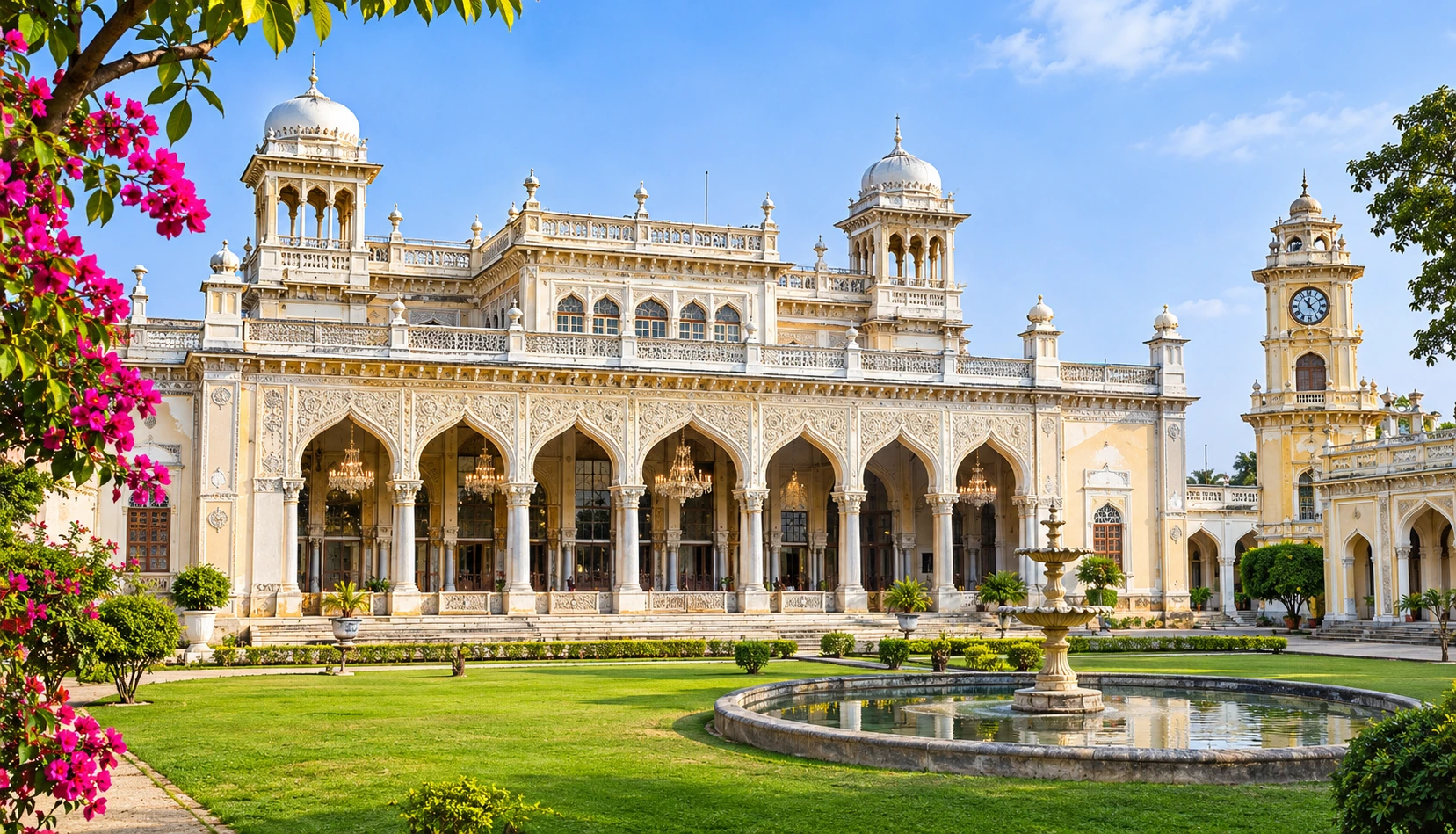
Quick Verdict
Chowmahalla Palace in Hyderabad is best known for its grand royal architecture, historical significance as the seat of the Asaf Jahi dynasty (the Nizams), and its opulent preservation of Deccan heritage.
Skip Chowmahalla Palace if you are visiting on a Friday, have less than two hours to explore, or have difficulty walking across large courtyards and uneven surfaces. Foreign visitors on a tight budget should also consider the higher entry fee and additional mobile photography charges.
Table of Contents
- Overview
- History & Background
- Architecture & Design
- Key Attractions Inside
- Historical Significance
- Best Time to Visit
- Timings
- Entry Fee & Tickets
- How to Reach
- Photography Rules
- Time Required
- Nearby Attractions
- Where to Stay & Eat
- Suggested Visit Itinerary
- Chowmahalla Palace Entry Fee
- Frequently Asked Questions
- Related Guides
Overview
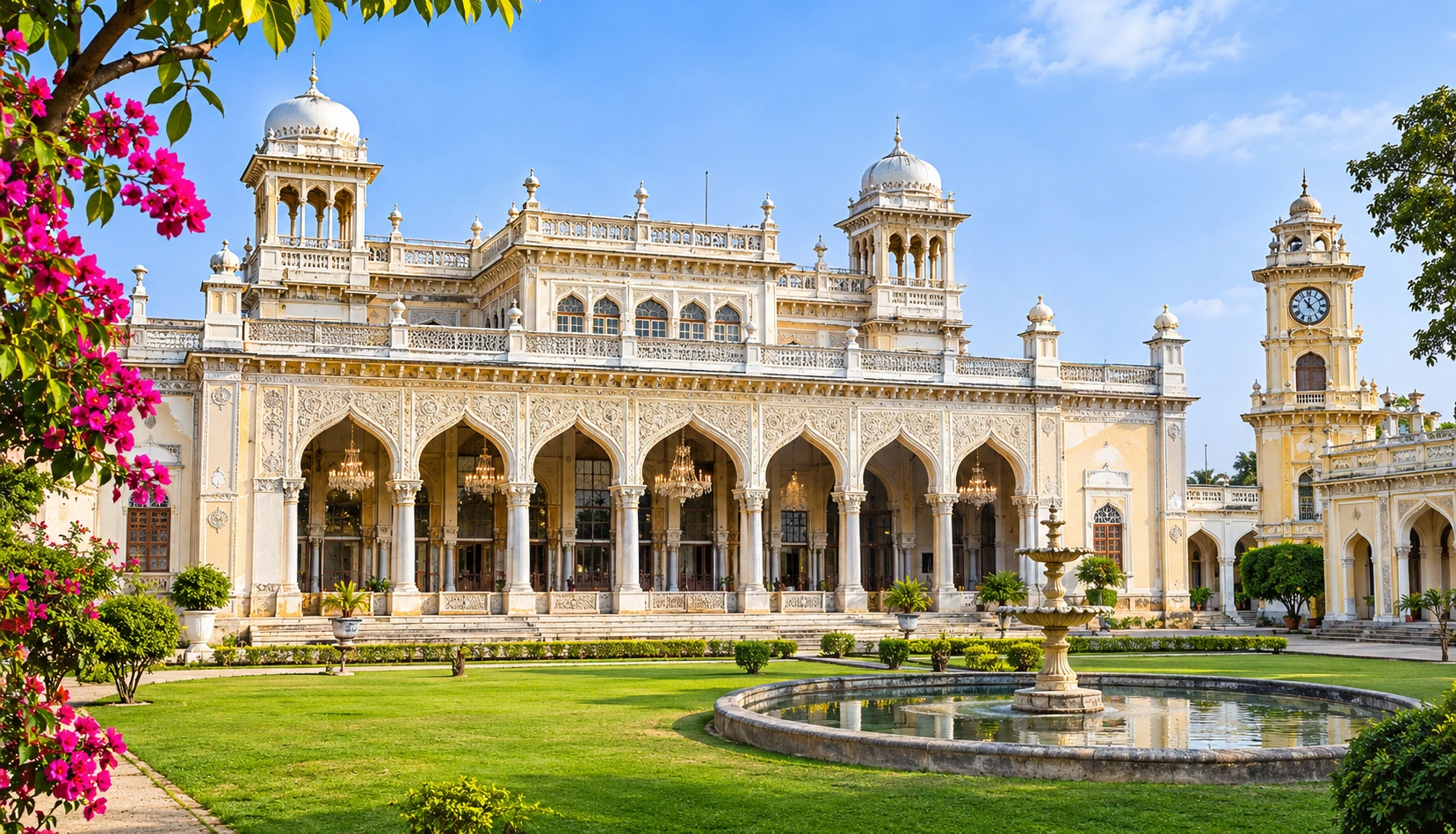
Built over several generations, Chowmahalla Palace preserves the royal history of Hyderabad and the former rulers of the Asaf Jahi dynasty. Chowmahalla Palace is a historic monument in the Khilwat area of Hyderabad's Old City, known for its royal halls, courtyards, collections, and Persian-influenced architecture.
The palace served as an important centre for royal life, official meetings, and ceremonies during the Nizams' rule. Its name refers to four palaces, which form part of a larger complex containing gardens, fountains, galleries, and historic buildings.
The complex covers approximately 12 acres today, compared with its original area of around 45 acres. The four palaces are Afzal Mahal, Aftab Mahal, Tahniyat Mahal, and Mahtab Mahal. The Khilwat Mubarak Durbar Hall is another major attraction, with its decorated interior and royal seating platform.
Visitors can also see the Bara Imam corridor, the historic clock tower, and collections of books, documents, arms, photographs, and vintage vehicles. The site suits history lovers, architecture students, families, and travellers exploring Hyderabad's Old City. However, walking through the extensive grounds takes time, and the outdoor sections can feel hot during summer.
History & Background
Chowmahalla Palace began taking shape in 1750 under Nizam Salabat Jung, the fourth ruler of the Asaf Jahi dynasty. The palace complex developed over several decades as successive Nizams added buildings and adapted the grounds for royal and administrative use.
The main construction period extended into the nineteenth century. Nizam Afzal-ud-Daulah, also known as Asaf Jah V, oversaw the completion of the palace complex between 1857 and 1869. The buildings served different purposes, including royal accommodation, official meetings, public audiences, and administrative work.
The palace became closely associated with the political and ceremonial life of the Nizams. The Khilwat Mubarak Durbar Hall served as a central venue for formal gatherings and royal ceremonies. The complex also contained residential areas, courtyards, gardens, and administrative rooms.
During the early twentieth century, Nizam Mir Osman Ali Khan, Asaf Jah VII, commissioned the new Khilwat Mubarak. Construction took place between 1912 and 1916. This hall became one of the best-known architectural features of the palace.
Following the end of the Nizams' rule in 1948, the palace remained an important part of Hyderabad's heritage. Its buildings and collections later received renewed attention through conservation work.
A major restoration programme began in 2005 under the patronage of Princess Esra. The work continued until 2010 and helped prepare the historic complex for public viewing. In 2010, Chowmahalla Palace received the UNESCO Asia-Pacific Heritage Award of Merit for cultural heritage conservation.
Today, the palace operates as a heritage attraction and museum. It preserves objects associated with the Nizams and provides visitors with a view of Hyderabad's royal history. Its continued conservation also helps protect historic architecture and collections for future generations.
Architecture & Design
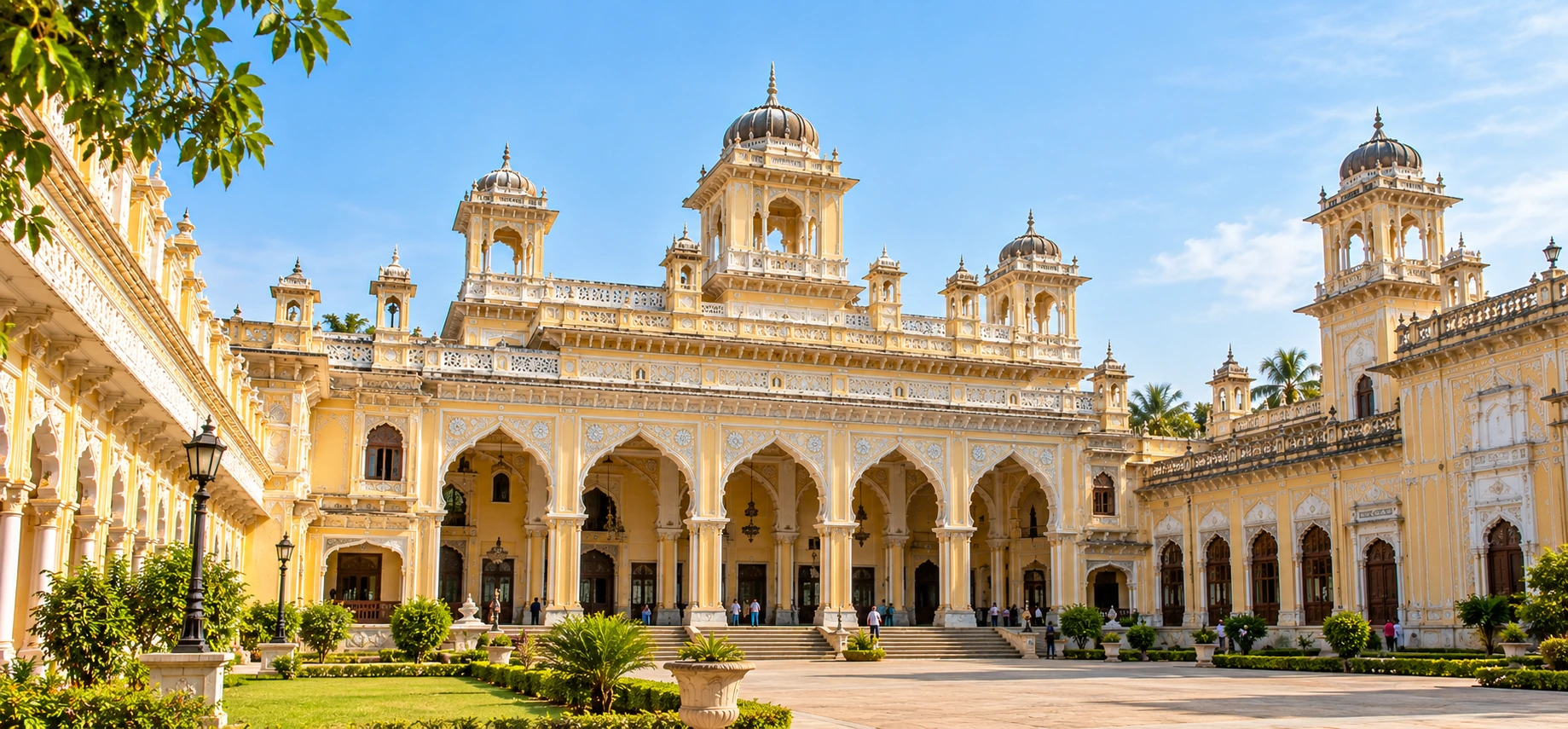
Chowmahalla Palace combines Persian influences with architectural features associated with Indian royal buildings and European classical design. The complex developed over more than a century, so its buildings do not all follow one uniform style.
The palace originally occupied approximately 45 acres. Its present grounds cover around 12 acres and include two main courtyards, several palace buildings, gardens, fountains, and exhibition spaces.
The Southern Courtyard is the oldest section. It contains four palaces: Afzal Mahal, Aftab Mahal, Tahniyat Mahal, and Mahtab Mahal. These buildings reflect the residential and ceremonial functions of the royal complex.
The Northern Courtyard contains the Bara Imam, a long corridor lined with rooms on its eastern side. These rooms once served administrative purposes. The Shishe-Alat building stands opposite the Bara Imam, creating a balanced arrangement around the courtyard.
Khilwat Mubarak forms the ceremonial centre of the complex. Its Durbar Hall features decorative interior work, a marble platform associated with the royal seat, and 19 Belgian crystal chandeliers. The hall combines local and foreign design influences.
The Clock Tower houses the Khilwat Clock, a historic mechanical timepiece that remains a notable feature of the palace. Gardens and fountains add open spaces between the buildings.
The Buggie Khaana houses vintage vehicles associated with the Nizams. Other exhibition areas display manuscripts, books, photographs, textiles, arms, and historical objects. Together, these spaces show how architecture, administration, royal life, and collections formed part of one palace complex.
Key Attractions Inside
Khilwat Mubarak Durbar Hall: The main ceremonial hall features 19 Belgian crystal chandeliers and a marble platform associated with the Nizams' royal seat.
Afzal Mahal: One of the four historic palaces in the Southern Courtyard, reflecting the residential and ceremonial functions of the royal complex.
Aftab Mahal: A historic palace building within the Southern Courtyard that forms part of the original four-palace arrangement.
Tahniyat Mahal: One of the four palace buildings that helps visitors understand the layout of the older royal residential complex.
Mahtab Mahal: A historic building in the Southern Courtyard, forming part of the group of four palaces that gave the complex its name.
Bara Imam: A long corridor of rooms in the Northern Courtyard that once housed the palace's administrative wing.
Khilwat Clock Tower: A historic tower containing the mechanical Khilwat Clock, known for its long-running mechanism.
Buggie Khaana: A display area containing vintage vehicles associated with the Nizams and their royal household.
Historical Significance
Chowmahalla Palace is important because it preserves the architectural and cultural history of Hyderabad under the Asaf Jahi dynasty. The complex served as an official royal residence and a centre for administration, ceremonies, and formal meetings.
Its development began in 1750 under Nizam Salabat Jung and continued through later generations of rulers. The palace reflects changes in royal life and architectural preferences across the eighteenth, nineteenth, and early twentieth centuries.
Khilwat Mubarak was a major ceremonial space where the Nizams held official gatherings and important events. The Bara Imam corridor represents the administrative side of palace life, while the residential buildings show how the grounds supported the royal household.
The collections add another layer of historical value. Manuscripts, books, photographs, textiles, arms, religious objects, and vintage vehicles preserve material connected with the rulers and their period.
The palace also holds importance for heritage conservation. Restoration work carried out between 2005 and 2010 helped preserve the buildings and prepare them for public access. In 2010, it received the UNESCO Asia-Pacific Heritage Award of Merit for cultural heritage conservation.
Chowmahalla Palace remains an important destination for understanding Hyderabad's royal past, architectural development, and cultural identity.
Best Time to Visit
October to March is generally the most comfortable period to visit Chowmahalla Palace because Hyderabad's weather is usually cooler than during the summer months.
The palace includes outdoor courtyards, gardens, and walking areas. Cooler weather makes it easier to move between buildings and spend time examining the historic interiors and collections.
Morning visits are practical for travellers who want to explore the complex before the afternoon heat becomes stronger. Arriving near the 10 a.m. opening time also leaves enough time to see the major attractions without rushing.
The summer months, especially April and May, can bring high temperatures. Visitors exploring the outdoor sections during this period should plan for the heat.
The monsoon season can bring rain to Hyderabad, which may affect comfort while walking through the courtyards. The palace is normally open from Saturday to Thursday and closed on Fridays.
Public holidays, special events, and visitor numbers can affect the atmosphere. A weekday morning is a sensible choice for travellers seeking a quieter visit, although crowd levels vary.
Timings
Chowmahalla Palace is open to visitors from Saturday to Thursday, between 10 a.m. and 5 p.m. It remains closed on Fridays.
The official ticket counter closes at 5 p.m. Visitors must leave the palace grounds by 5:30 p.m. Arriving earlier gives you more time to explore the courtyards, galleries, and historic buildings.
The palace recommends allowing approximately two hours for a visit. Travellers interested in reading the displays and examining the collections in detail can plan their time accordingly.
Photoshoots are not permitted, and filming or videography is prohibited within the premises. Mobile photography is permitted for a separate fee under the published visitor rules.
Prices, hours and menus can change, so readers should check the official website before they go.
Entry Fee & Tickets
The published admission fee is ₹150 for Indian adults and ₹500 for foreign visitors, with nationality determined using the visitor's passport. Children below 10 years pay ₹50.
Mobile photography costs an additional ₹50. This charge is separate from the admission ticket and applies to the permitted mobile photography option.
The ticket counter closes at 5 p.m. Visitors should plan to arrive early enough to purchase tickets and explore the palace before closing time.
The palace's official visitor information lists these prices for general admission. Separate filming and videography are prohibited within the premises, and photoshoots are not permitted.
The published admission categories do not establish a separate discounted ticket for every possible group. Visitors should use the applicable category listed by the palace when purchasing admission.
How to Reach
By air: Rajiv Gandhi International Airport serves Hyderabad. From the airport, travel by road towards the Old City and the Khilwat area, where the palace is located.
By train: Secunderabad Junction is a major railway station serving Hyderabad. From the station, continue by road towards Charminar and the palace's Motigalli address.
By metro: Hyderabad Metro provides connections to parts of the city. The palace is in the Old City, so you will need a further road journey from a suitable metro station.
By bus: Local buses serve the Charminar and Old City area. From the nearby bus stops, continue on foot or use local transport to reach the palace entrance.
By road: Chowmahalla Palace is accessible from different parts of Hyderabad. Charminar is a useful local landmark when travelling towards the palace.
By ride-hailing: App-based rides can take visitors to the palace's Motigalli address. Traffic and access conditions in the Old City can affect the final approach.
Photography Rules
Mobile photography is permitted at Chowmahalla Palace for a separate fee of ₹50, according to the official visitor information. This charge is additional to the admission ticket.
Shooting, filming, and videography are strictly prohibited within the palace premises. Photoshoots are also not permitted, so visitors should distinguish ordinary permitted mobile photography from organised photography sessions.
The published visitor information does not provide a complete list of rules for tripods, drones, flash photography, or selfie sticks. Visitors should follow the instructions displayed by palace staff and avoid photographing restricted displays or areas.
The palace contains decorated halls, historic buildings, courtyards, and collections that are visually interesting. Photography must remain within the permitted rules and must not interfere with other visitors or the protection of historic objects.
Time Required
Approximately 2 hours is the recommended time for a standard visit to Chowmahalla Palace.
First 15 minutes: Purchase admission and enter the palace grounds.
Next 25 minutes: Walk through the courtyards and examine the four palace buildings.
Next 30 minutes: Spend time at Khilwat Mubarak and its ceremonial interior.
Next 20 minutes: Visit the Bara Imam corridor and the Clock Tower area.
Next 20 minutes: Explore the available displays of books, photographs, arms, and other historical objects.
Final 10 minutes: Visit the vintage vehicle display and return towards the exit.
This is a suggested allocation rather than an official timed route. Visitors who read every display or spend longer in the galleries should allow additional time.
Nearby Attractions
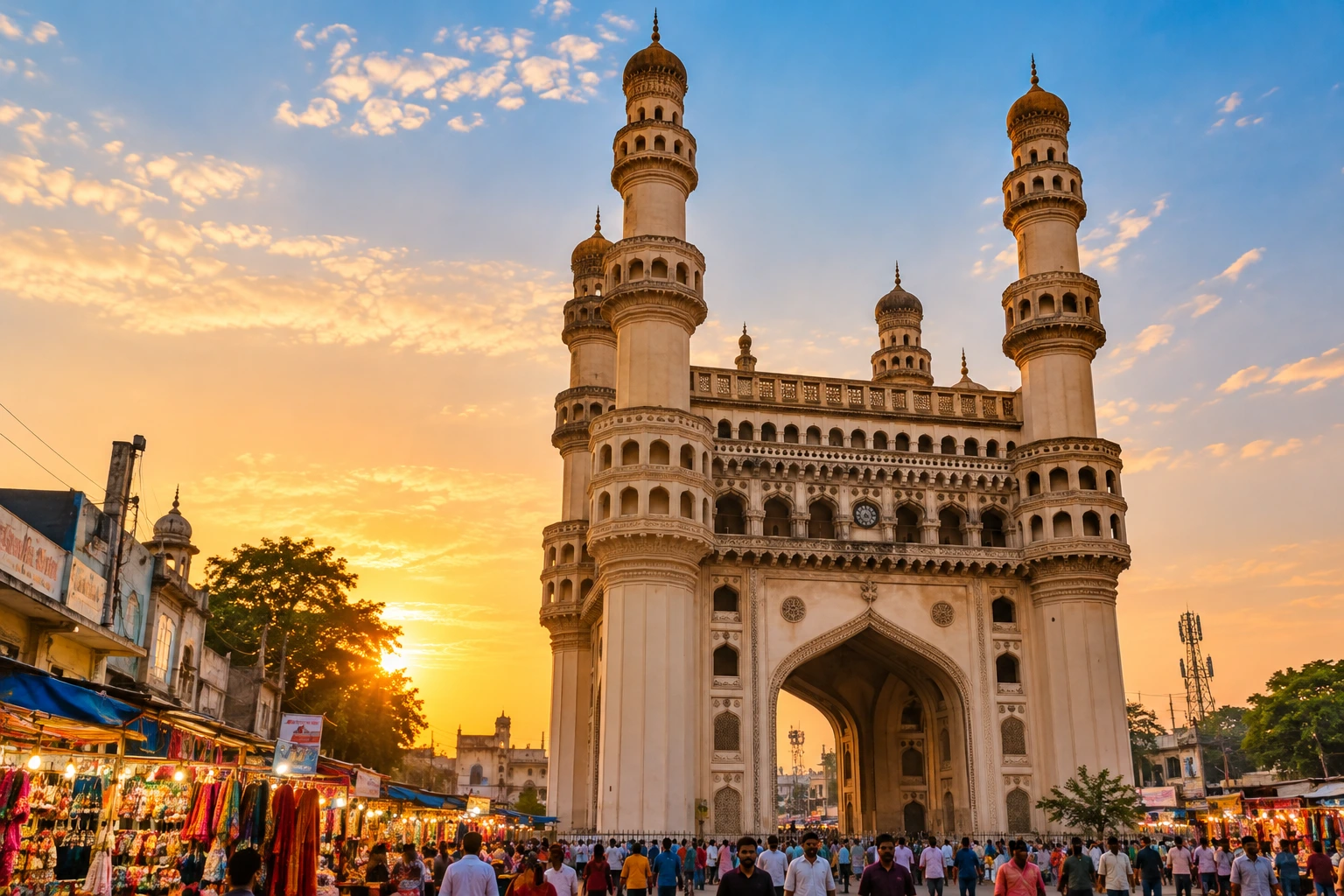
Charminar: A historic monument in Hyderabad's Old City that combines well with a visit to the palace.
Mecca Masjid: A major historic mosque near Charminar, known for its large prayer hall and traditional architecture.
Laad Bazaar: A traditional market area known for bangles, clothing, accessories, and shopping around the Charminar neighbourhood.
Purani Haveli: A historic palace complex associated with the Nizams, with collections connected to Hyderabad's royal heritage.
Salar Jung Museum: A major museum with collections of art, decorative objects, historical items, and works from different regions.
Sudha Cars Museum: A museum featuring unusual and creatively designed vehicles, offering a different experience from the palace's royal collections.
Where to Stay & Eat
Stay
Taj Falaknuma Palace (Falaknuma, upscale): A heritage hotel in a former palace setting, suited to travellers seeking a royal-style stay.
The Golkonda Hotel (Masab Tank, mid-range to upscale): A full-service hotel with accommodation and dining facilities for visitors exploring Hyderabad.
FabHotel Arastu (Nampally area, budget): An accommodation option for travellers seeking a more economical base for visiting the city.
Eat
Hyderabadi dum biryani: A rice dish cooked with spices and meat or vegetables, widely associated with Hyderabad's food traditions.
Haleem: A slow-cooked preparation of meat, lentils, and grains, especially associated with Hyderabad during Ramadan.
Irani chai: A strong, milky tea commonly served in Hyderabad's traditional tea shops.
Osmania biscuits: Local biscuits often eaten with Irani chai in Hyderabad's cafés.
For meals near the palace, the Charminar and Old City areas have restaurants and traditional food shops. Specific restaurant menus and availability vary by establishment.
Suggested Visit Itinerary
First 15 minutes: Arrive at the main entrance, purchase your ticket, and enter the palace complex.
Next 20 minutes: Walk through the Southern Courtyard and see Afzal Mahal, Aftab Mahal, Tahniyat Mahal, and Mahtab Mahal.
Next 30 minutes: Visit Khilwat Mubarak and examine the Durbar Hall's chandeliers, decorative details, and royal seating platform.
Next 20 minutes: Continue towards the Northern Courtyard and explore the Bara Imam corridor and the historic Clock Tower area.
Next 20 minutes: Spend time with the available displays of books, manuscripts, photographs, textiles, and arms.
Next 15 minutes: Visit the Buggie Khaana to see the vintage vehicles associated with the Nizams.
Final 10 minutes: Return towards the exit and prepare to continue to Charminar or another nearby attraction.
This itinerary is a suggested plan for a two-hour visit. The time spent in each area depends on visitor interest and access to individual displays.
Chowmahalla Palace Entry Fee
Chowmahalla Palace charges ₹150 for Indian adults and ₹500 for foreign visitors, according to its published admission information. Children below 10 years pay ₹50, while permitted mobile photography costs an additional ₹50.
The entry ticket allows visitors to access the palace grounds and the visitor areas open to the public. The palace contains courtyards, historic buildings, ceremonial spaces, and displays connected with the Nizams.
The official ticket counter closes at 5 p.m., so visitors should arrive with enough time to purchase admission and explore the complex. The palace closes to visitors on Fridays.
Visitors planning a trip should budget separately for admission, mobile photography, local transport, and food. The published visitor information does not establish a single combined price for all these expenses.