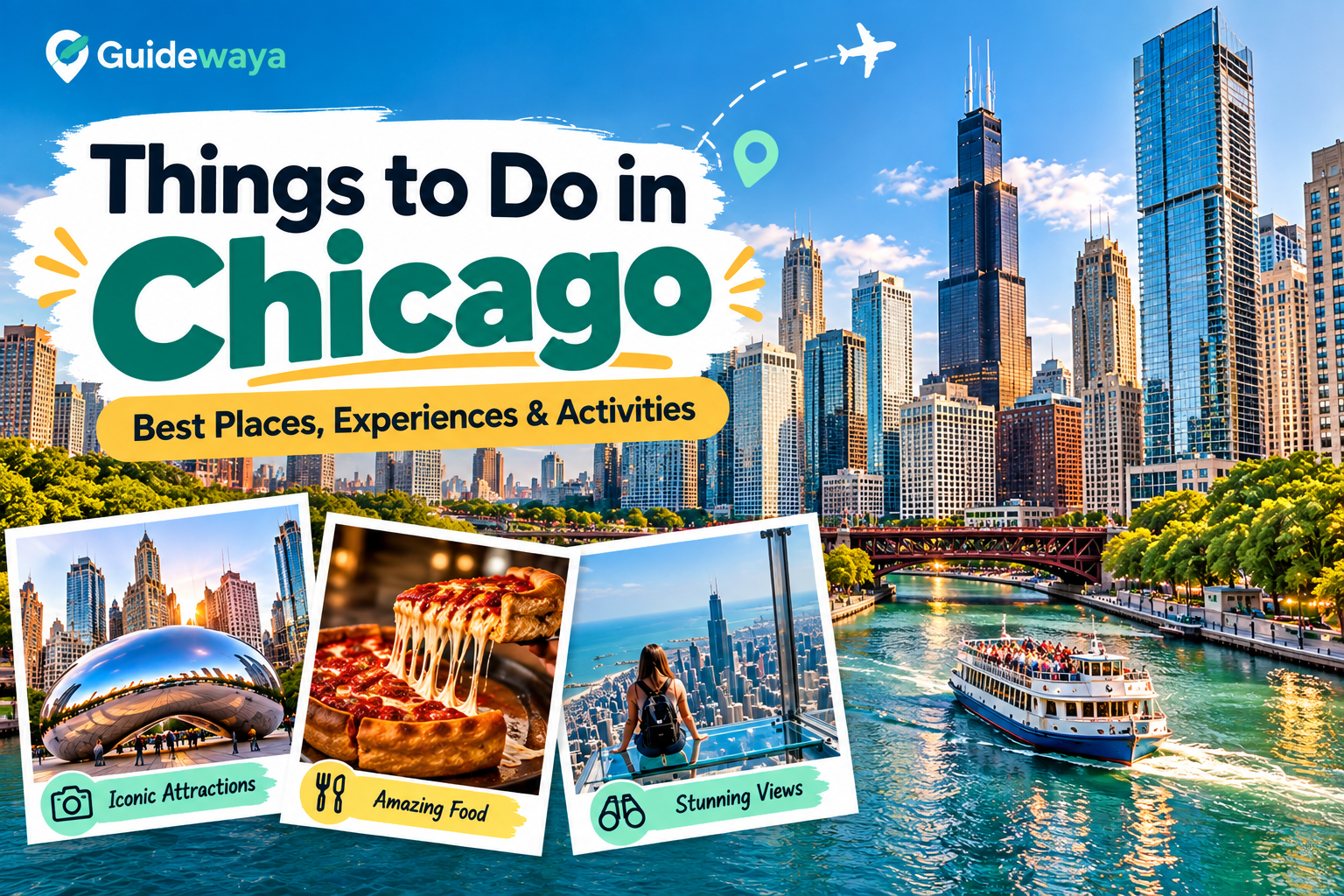
If this is your first trip to Chicago, my biggest advice is simple: don't try to see the whole city in one day.
Chicago is big, and its best experiences are spread across different areas. You have the famous skyline downtown, the Chicago River, Lake Michigan, world-class museums, neighborhood restaurants, parks, sports, and plenty of free places to explore.
The easiest way to enjoy the city is to plan by area.
Start with downtown and Millennium Park, walk toward the river, add an architecture cruise, and finish with dinner or a skyline view. If you have more time, move beyond downtown and explore places like Lincoln Park, Pilsen, Wicker Park, Chinatown, or Hyde Park.
In this guide, I'll walk you through the best things to do in Chicago, how much they can cost, how much time to allow, and how I would organize the city into a realistic trip.
Chicago at a Glance
For a first visit, these are the experiences I'd put near the top of your list:
Millennium Park and Cloud Gate
Chicago Riverwalk
Chicago architecture river cruise
Art Institute of Chicago
Museum Campus
Skydeck Chicago or 360 CHICAGO
Navy Pier
Lake Michigan and the lakefront
Lincoln Park, Pilsen, Wicker Park, or Chinatown
Chicago deep-dish pizza and Italian beef
A sports game, comedy show, or live music night
You don't need to visit all of them. Your available time matters more than the size of your checklist.
1. Start Your Chicago Trip at Millennium ParkSee The Bean, then keep walking
If I were helping a first-time visitor plan their first morning in Chicago, Millennium Park would be one of my first stops.
The park is right in the middle of downtown and puts you close to several other attractions. The most famous sight is Cloud Gate, usually called The Bean.
Yes, take the photo. But don't leave immediately.
Walk around the park, check out the public art, enjoy the gardens, and then continue toward the Art Institute or Chicago Riverwalk.
If you're traveling with kids, Maggie Daley Park is nearby and is a useful place to give them some time to play.
Price: Free
Time: 1–2 hours
Best for: First-time visitors, families, photographers
Guide tip: Come earlier in the day if you want a more relaxed photo at The Bean.
2. Take a Chicago Architecture River Cruise
This is the tour I would prioritize
Chicago's skyline looks impressive from the street, but it makes much more sense when someone explains what you're looking at.
An architecture river cruise takes you along the Chicago River while a guide talks about the city's buildings, bridges, architecture, and history.
For a first-time visitor, this is one experience I'd strongly consider adding to the itinerary.
Typical price: Around $40–$70 per adult, depending on the operator, date, and ticket type
Time: About 1–2 hours
The best part is that you don't have to spend the entire day walking between buildings. You sit back, listen, take photos, and see downtown from the water.
How I'd fit it into your day
Try this route:
Millennium Park → lunch → Riverwalk → architecture cruise → dinner
That keeps your day in roughly the same area instead of wasting time traveling across the city.
3. Walk the Chicago RiverwalkOne of the best free things to do in Chicago
You don't need a ticket to enjoy the Chicago Riverwalk.
The walkway follows the river through downtown and gives you some of the city's best close-up views of buildings, bridges, boats, and the skyline.
I like this as a flexible part of the itinerary because you don't have to decide exactly how long you'll stay.
You might walk for 30 minutes, or you might stop for food and spend two hours around the river.
Price: Free
Time: 30 minutes–2 hours
If your schedule is tight, combine it with your architecture cruise and downtown sightseeing.
Guide tip: Don't rush through the Riverwalk just because it's free. Some of the best travel moments happen when you simply stop, look around, and enjoy the city.
4. Spend a Few Hours at the Art Institute of ChicagoIf you enjoy art, history, or beautiful indoor spaces, make time for the Art Institute of Chicago.
It's conveniently located beside Millennium Park, so you don't need to create a separate trip just to visit it.
You could easily spend several hours here, but don't feel pressured to see every gallery.
I recommend choosing a few collections before you arrive. That way, you're exploring with a purpose instead of getting tired halfway through the museum.
Typical price: Around $25–$40+ per adult, depending on current admission
Time: 2–4 hours
Best for: Art lovers, couples, solo travelers, rainy days
Guide tip: If you're only in Chicago for two days, give the museum a few focused hours rather than trying to see everything.
5. Choose One Chicago Observation DeckSkydeck Chicago vs 360 CHICAGO: Which One Should You Choose?You don't need to visit both observation decks unless skyline views are a major reason for your trip.
The main difference comes down to location, height, and the type of experience.
Skydeck Chicago
Skydeck is located inside Willis Tower in the Loop. The observation area is on the 103rd floor, with views from about 1,353 feet above the ground.
Its most famous feature is The Ledge, where you can step into glass boxes that extend outside the building.
Skydeck is a good fit if you want:
Views of downtown and the Chicago River
The higher observation point
The famous Ledge experience
An attraction that fits easily into a Loop sightseeing day
360 CHICAGO
360 CHICAGO is located at 875 N. Michigan Avenue, near the Magnificent Mile. The observation deck is on the 94th floor, around 1,030 feet above the ground.
Its signature experience is TILT, a moving glass platform that extends outward from the building. You also get wide views of Lake Michigan and the Magnificent Mile.
360 CHICAGO is a good fit if you want:
Lake Michigan views
Magnificent Mile access
The TILT experience
A skyline attraction in the Michigan Avenue area
The main difference
In simple terms, Skydeck focuses more on the Willis Tower and downtown experience, while 360 CHICAGO gives you a different view of the city with Lake Michigan and the Magnificent Mile in the foreground.
360 CHICAGO currently lists general admission from $30 for adults and $20 for children, with prices varying by date and time. TILT is an additional purchase, currently listed at $14–$18 depending on the selected time.
360 CHICAGO is currently open daily from 9 AM to 11 PM, with last entry one hour before closing.
Planning tip: You don't need to pay for both unless observation decks are a major part of your Chicago trip. Choose the one that fits your sightseeing route and the type of view you want.
6. Add Free Chicago Attractions to Your TripYou don't need to spend money every few hours to enjoy Chicago.
Some of my favorite types of stops for a budget-friendly itinerary are completely free.
Millennium Park
See Cloud Gate, walk around the gardens, and explore the public spaces.
Cost: Free
Chicago Riverwalk
Walk along the river and enjoy the architecture.
Cost: Free
Chicago Cultural Center
Visit this beautiful downtown building and look for its famous Tiffany glass dome.
Cost: Free for general access
Lincoln Park Zoo
A useful free activity, especially for families.
Cost: Free
Lake Michigan
Walk along the lakefront and enjoy Chicago's skyline from a different angle.
Cost: Free
Public Art
Keep an eye out for murals, sculptures, and public installations as you move around the city.
Guide tip: I would add one or two free activities to every day. That gives your budget more room for museums, cruises, restaurants, or skyline experiences.
7. Best Things to Do in Chicago With KidsChicago is surprisingly easy to enjoy with children because you can mix indoor attractions with parks and outdoor activities.
Shedd Aquarium
A strong choice for children who enjoy marine life and animals.
Budget: Around $40–$50+ per person
Field Museum
Go here if your family enjoys dinosaurs, natural history, animals, or ancient cultures.
Budget: Around $25–$40+ per person
Museum of Science and Industry
A good option for children who prefer science, technology, and hands-on exhibits.
Budget: Around $20–$40+ per person
Lincoln Park Zoo
Free, outdoors, and easy to combine with the neighborhood.
Cost: Free
Maggie Daley Park
After a few hours inside a museum, children may simply want somewhere to run around.
Cost: Free for general park access
Navy Pier
Navy Pier combines lake views, food, entertainment, and family attractions.
Budget: Free to enter; allow roughly $10–$40+ for paid activities.
Family planning tip
Don't put two or three large museums on the same day.
I'd rather plan:
One major attraction + lunch + one outdoor activity
than spend the entire day moving from one ticketed attraction to another.
8. Things to Do in Chicago at NightChicago becomes a different city after sunset.
If you want a relaxed evening, start with dinner and a walk. If you want entertainment, there are plenty of options.
See the Skyline
Visit your chosen observation deck around sunset if the schedule works.
Budget: Around $30–$60+
Walk Around the River
The downtown buildings look completely different when they're lit up.
Cost: Free
Watch a Sports Game
Depending on the season, you may be able to see baseball, basketball, hockey, football, or another live sporting event.
Budget: Roughly $30–$150+ per ticket, depending heavily on the event and seat.
See a Show
Chicago has theatre, comedy, improv, jazz, blues, and live music.
Budget: Around $20–$100+
Have a Chicago Food Night
For a casual dinner, plan around $15–$30 per person. A mid-range dinner can easily reach $30–$60, while higher-end restaurants can cost $60 or more.
9. Leave Downtown and Explore a Chicago NeighborhoodThis is where I would change the pace of the trip.
Downtown gives you the famous sights, but neighborhoods show you a different side of Chicago.
Lincoln Park
Choose Lincoln Park if you want parks, restaurants, the zoo, and a relaxed afternoon.
Best for: Families and outdoor activities
Pilsen
Come here for murals, Mexican-American culture, food, and photography.
Best for: Culture, street art, and food
Wicker Park
Explore independent shops, restaurants, cafes, and nightlife.
Best for: Food, shopping, and nightlife
Chinatown
A great choice if food is one of your main reasons for traveling.
Best for: Food and cultural experiences
Hyde Park
Consider Hyde Park for museums, architecture, the University of Chicago area, and the lakefront.
Best for: History, culture, architecture
Guide tip: Don't try to visit five neighborhoods in one afternoon. Pick one and give yourself enough time to actually experience it.
10. Eat Your Way Through Chicago
Chicago is one of those cities where food can become part of the travel experience. You do not have to visit expensive restaurants to enjoy it. From classic deep-dish pizza to neighborhood food spots, there are plenty of local dishes worth trying during your trip.
Try Chicago-Style Deep-Dish Pizza
Deep-dish pizza is probably the first food most visitors associate with Chicago. Unlike a regular thin pizza, it has a thick crust with a deep edge that holds plenty of cheese, sauce, and toppings.
It is filling, so plan to share one pizza if you are traveling with someone. Also, keep some extra time for the meal because deep-dish pizza usually takes longer to prepare than a standard pizza.
Have a Chicago-Style Hot Dog
A Chicago-style hot dog is another local classic. It is usually served with toppings such as mustard, onions, relish, tomato, a pickle spear, sport peppers, and celery salt.
One thing you may notice is that traditional Chicago-style hot dogs are not normally served with ketchup. If you want to try the local version, order it the classic way.
Try an Italian Beef Sandwich
Italian beef is a great choice if you want something more filling. The sandwich usually comes with thinly sliced beef, Italian-style seasoning, and peppers or giardiniera.
You can also choose how wet you want the sandwich. If you are trying it for the first time, ask the restaurant what they recommend. It can be messy, but that is part of the experience.
Look for a Jibarito
For something different, try a jibarito. This Puerto Rican-inspired Chicago favorite uses fried plantains instead of traditional bread and is often filled with meat, cheese, lettuce, tomato, and other toppings.
It is especially worth looking for when you explore Chicago's neighborhoods rather than staying only around the main downtown attractions.
Explore Chicago's Neighborhood Food Scene
Some of Chicago's best food experiences are outside the main tourist areas. Neighborhoods such as Pilsen, Chinatown, Wicker Park, and Logan Square offer restaurants, bakeries, cafes, and casual food spots with different flavors and local character.
If you have extra time, choose one neighborhood and spend a few hours exploring it. Grab lunch, walk around the area, stop at a cafe, and try a local dessert. This can give you a better feel for Chicago beyond its famous attractions.
A Simple Food Plan for Your Chicago Trip
If you are visiting Chicago for only two or three days, you do not need to plan every meal around famous restaurants. Instead, try a mix of classic Chicago food and neighborhood dining.
For example, have deep-dish pizza on one day, try a Chicago-style hot dog or Italian beef on another, and spend one meal exploring a neighborhood restaurant. This gives you a good introduction to Chicago's food culture without spending your entire trip looking for restaurants.
And remember, Chicago's food scene is much bigger than its famous dishes. Leave some room in your itinerary for bakeries, coffee shops, casual restaurants, and local spots you discover while walking around the city.
11. My Chicago Itinerary for 1, 2, or 3 DaysIf You Have 1 Day
Keep the day compact.
Morning: Millennium Park + The Bean
Late morning: Art Institute
Afternoon: Riverwalk + architecture cruise
Evening: Chicago dinner + skyline view
Don't try to add a distant neighborhood.
If You Have 2 Days
Day 1 — Downtown Chicago
Millennium Park
Art Institute
Riverwalk
Architecture cruise
Dinner downtown
Day 2 — Lakefront and Museums
Museum Campus
Lake Michigan
Navy Pier
One observation deck
Evening entertainment
This gives you a good first look at Chicago without rushing every hour.
If You Have 3 Days
Day 1 — Classic Chicago
Millennium Park → Art Institute → Riverwalk → architecture cruise → dinner
Day 2 — Museums and Lakefront
Museum Campus → Lake Michigan → Navy Pier → observation deck
Day 3 — Neighborhood Chicago
Choose Pilsen, Lincoln Park, Wicker Park, Chinatown, or Hyde Park.
If you ask me how I'd structure a first three-day trip, this is the kind of balance I'd use: one downtown day, one lakefront/museum day, and one neighborhood day.
12. How Much Does a Chicago Trip Cost?
Chicago can work for different types of travelers, from budget visitors to people looking for a more comfortable city break. Your total cost will mainly depend on where you stay, how many days you visit, how often you eat out, and how many paid attractions you choose.
Budget Trip
If you are traveling on a budget, focus on affordable accommodation, public transportation, free attractions, and casual restaurants.
You can spend your day exploring places such as Millennium Park, the Chicago Riverwalk, Lincoln Park, and the lakefront without paying an entrance fee. Using the CTA instead of taxis or rideshares can also help keep transportation costs lower.
For food, look for casual restaurants, food markets, local sandwich shops, and neighborhood cafes instead of eating at expensive restaurants for every meal.
Mid-Range Trip
A mid-range Chicago trip gives you more flexibility. You can stay in a comfortable hotel, eat at a mix of casual and well-known restaurants, and visit several paid attractions.
A typical day might include a major attraction in the morning, lunch at a local restaurant, a neighborhood walk in the afternoon, and dinner followed by an evening activity.
This is a good approach if you want to experience Chicago without making every decision based on price.
Comfortable or Luxury Trip
A more comfortable trip can include a higher-end hotel, taxis or rideshares when convenient, better restaurants, and several premium experiences.
You may also choose attractions such as a Chicago architecture cruise, a skyline observation deck, or special dining experiences. These choices can increase your daily spending quickly, so it is useful to decide which experiences matter most before your trip.
Main Costs to Plan For
When creating your Chicago budget, think about these main expenses:
Accommodation: Hotel or other lodging costs
Food: Breakfast, lunch, dinner, snacks, and drinks
Transportation: CTA trains and buses, taxis, or rideshares
Attractions: Museums, observation decks, cruises, and other ticketed experiences
Shopping: Souvenirs, clothing, gifts, and local products
Extra costs: Tips, taxes, airport transportation, and unexpected expenses
A Simple Way to Save Money
You do not need to avoid paid attractions completely to save money. Instead, mix paid experiences with free activities.
For example, you could visit a museum or observation deck in the morning and spend the afternoon walking along the Chicago Riverwalk, exploring Millennium Park, or relaxing near Lake Michigan.
Also, avoid booking every activity separately without checking your daily route. Grouping attractions that are close to each other can save both time and transportation costs.
Travel tip: Keep a small extra amount in your budget for taxes, tips, transportation changes, and spontaneous food stops. A flexible budget makes your Chicago trip much easier to manage.
13. Getting Around ChicagoYou don't usually need a rental car for a first Chicago trip.
For downtown sightseeing, walking is often the easiest option.
Use CTA trains and buses when you're traveling between neighborhoods. Rideshare can make sense when you're carrying luggage, traveling late, or trying to save a lot of time.
I would plan your days geographically.
For example:
Millennium Park + Art Institute + Riverwalk
makes more sense than:
Millennium Park → Pilsen → Magnificent Mile → Hyde Park
in the same afternoon.
The less time you spend traveling across the city, the more time you have to actually enjoy Chicago.
14. A Few Chicago Planning Tips From a Tour-Guide PerspectiveHere's the advice I'd give someone before they start booking everything.
Don't fill every hour
Leave some space for food, photos, shopping, and unexpected stops.
Choose one observation deck
You don't need to pay twice for similar skyline views.
Book major experiences ahead
Architecture cruises, observation decks, sports games, and popular shows can be worth booking in advance.
Check current prices
Ticket prices and schedules can change. Always check the attraction's official website before booking.
Explore beyond downtown
Even if you only have three days, try to spend at least half a day in one neighborhood.
Don't underestimate walking
Chicago sightseeing can involve a lot of walking. Comfortable shoes will make a bigger difference than you might expect.
Keep weather in mind
Chicago weather can change your plans. Having one indoor activity ready for a rainy or very cold day makes the itinerary easier to manage.
Frequently Asked QuestionsWhat are the best things to do in Chicago for first-time visitors?
Start with Millennium Park, the Chicago Riverwalk, an architecture cruise, one major museum, the lakefront, and one observation deck. If you have more time, explore a neighborhood such as Pilsen, Lincoln Park, Wicker Park, or Chinatown.
How many days do I need in Chicago?
Two or three days is a good starting point for a first visit. A week gives you more time for neighborhoods, museums, food, sports, parks, and nightlife.
What are the best free things to do in Chicago?
Millennium Park, Chicago Riverwalk, Chicago Cultural Center, Lincoln Park Zoo, lakefront walks, and public art are excellent free options.
Is Chicago good for families?
Yes. Shedd Aquarium, Field Museum, Lincoln Park Zoo, Maggie Daley Park, Navy Pier, and Museum of Science and Industry give families plenty of choices.
What is Chicago famous for?
Chicago is famous for its architecture, skyline, deep-dish pizza, Chicago-style hot dogs, museums, sports, blues and jazz, Lake Michigan, and distinctive neighborhoods.
Can I visit Chicago without a car?
Yes. Downtown is highly walkable, while CTA trains and buses make it possible to reach many neighborhoods without renting a car.
Should I visit Skydeck or 360 CHICAGO?
Choose based on your itinerary. Skydeck is convenient for the Loop and The Ledge, while 360 CHICAGO works well if you're around Michigan Avenue and want Lake Michigan views.
What is the best neighborhood to explore in Chicago?
It depends on what you want. Choose Lincoln Park for parks and families, Pilsen for murals and culture, Wicker Park for food and nightlife, Chinatown for food, and Hyde Park for museums and architecture.
Final ThoughtsChicago is not a city I'd recommend trying to “finish.”
Give yourself time to look around.
Take the architecture cruise. Walk beside the river. Sit in Millennium Park for a while. Try a local dish. Watch the skyline from Lake Michigan. Spend an afternoon in one neighborhood.
And don't worry if you miss a few attractions.
For a first trip, I'd rather see you experience six places properly than rush through fifteen just to say you visited them.
If you have one day, stay focused on downtown. With two or three days, add the lakefront and a neighborhood. With a week, slow down and let Chicago's food, culture, museums, sports, and local areas become part of the trip.
That's the easiest way to turn a sightseeing checklist into a real Chicago experience.